TWO HEAPS
Don't neglect the little ones.

”I see in this world two heaps—one of human happiness and one of misery: now, if I can take but the smallest bit from the second heap, and add to the first, I carry a point. If, as I go home, a child has dropped a half-penny, and if by giving it another, I can wipe away its tears, I feel that I have done something. I should be glad indeed to do great things, but I will not neglect such little ones as this.”
John Newton (1725-1807).
quoted in the Independent Beacon
Edited and published by Gilbert Vale (1788-1866).
1:5 October 1848
p. 129
The quote itself is from John Newton, the English cleric and abolitionist who wrote "Amazing Grace" and "Glorious Things of Thee Are Spoken.” His story has been romanticized as if he had some great awakening as he witnessed the suffering of blacks transported on the vessels on which he served. Not so. As usual, the real history is more interesting. Briefly …
He was impressed into the Royal Navy … jerked off a road when he was just 18 years old, but fled the navy for the slave trade. He ended up himself enslaved in Africa for a time. His conversion to Christianity came after he was rescued by a ship’s captain hired by his father to find and bring him home. When the ship began to sink in the midst of a great storm off the coast of Ireland, prayed to the god of the Bible for mercy and the storm abated. Failing to take into consideration the “correlation is not causation” fallacy, he began to study and make his conversion from “heathen” to Christian.
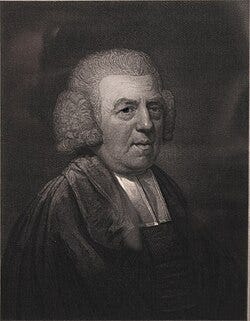
John Newton portrait 1807.
It wasn’t until 1788 - incidentally, the year of Gilbert Vale’s birth - 34 years after Newton’s retirement from the slave trade, that he spoke out on the subject in a pamphlet entitled Thoughts Upon the Slave Trade. Newton described the horrors of the Triangle Trade and apologized for "a confession, which ... comes too late ... It will always be a subject of humiliating reflection to me, that I was once an active instrument in a business at which my heart now shudders." He had copies sent to every Member of Parliament and the pamphlet sold briskly. It was well-timed.
Slavery in England proper ended with the 1807 Great Slave Trade Act. Newton lived to see it passed. But slavery remained legal in most of the British Empire until the passing of the Slavery Abolition Act 1833. The USA would not follow for another 32 years and the slaughter of half a million when the Slave Power of the American South attempted to force its expansion on the rest of the nation.
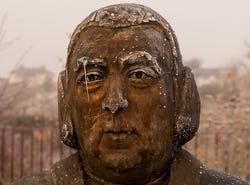
Detail of a statue memorializing Newton in County Donegal, Ireland.
The key point in this post is the quotation. It is arguably more characteristic of Vale - a skeptic and a deist who opposed slavery his entire life - than Newton himself … who awakened slowly and long after it no longer profited him. Better late than never comes to mind.
Remember, this Substack depends on your support. You don’t need a paid subscription in order to help out. Just LIKE, SHARE, and COMMENT. Let your friends and colleagues know that it’s always free and hopefully always interesting and worthwhile. And …
Peggy thanks for your comment. You make a very good point, but I think that we cannot give this man or any person of his time a pass because "back in those days you could only do it through religion/" Not so. Consider the examples of Thomas Paine, Gilbert Vale, Benedict Spinoza, Ernestine Rose, Mary Wollstonecraft, John Tolland, and a very long and distinguished list of those who "did it" with no excuses, no crutches, and no "Christianity." NOT to overlook the many non-Christians like First Nations people, so-called pagan Africans, and others who didn't need an imaginary friend in the sky to tell them that slavery was and is a social blight and human atrocity. .
This seems to me to be a story of a man who tried to reclaim himself. And I guess back in those days you could only do it through religion.? today luckily we need not turn to religion in order to expiate our sins.